July 2000
| NEWSLETTER |
Hi Everyone,
I hope the July newsletter finds everyone well, enjoying their summer, surviving the heat, droughts and gas prices!!! Florida has been in an awful drought, but the summer rains have finally begun and yards are starting to green up. With the rain, comes tremendous humidity, heat and mosquitoes. However, the yards are beautiful, the flowers are perking up, the lakes and ponds are beginning to look like lakes and ponds again and we are very grateful for the rain.
Time has sure flown by the first half of this year! Our only daughter was married April 1st, so you know what Jan-Mar was like for us. Now, one of our sons and our daughter in-law is expecting our first grandchild on July 12th, which is just two weeks away. I'm so excited I can hardly stand it!! My daughter in-law (Cheryl) has been putting the finishing touches on the baby's room, which turned out darling. I plan to feature what she did to decorate the baby's room in the near future. So you will want to be watching for that.
Summer can be a great time to catch up on some projects and makeovers for your home, so I thought I would share some practical information and "Rules of Thumb" that will help you with these projects.
I hope the month of July is a wonderful family time for you and by this time next month, I will be able to report on my new grandson!
| Sizes & Measurements "Decorating Rules of Thumb |
How big should the
area
rug be? What size lamp should the nightstand have, and what
measurements and sizes of pictures should I use to decorate my walls?
When we stop to think about it, sizes and measurements are a common
element in decorating and an area that will leave the average home
decorator in a ponder. Every home will have it's unique design elements
that can make these decisions difficult, however there are some
"Decorating rules of thumb" that will help you get started on the
right track.
 |
How do I know the correct size area rug for my home? |
| Click to enlarge |
The most popular locations to use area rugs are the
dining room and the living room. The rules of thumb for these locations
are pretty universal, but before placing a rug you must consider
the size of your room. If you have a large space, the
furniture
grouping will dictate the size of the rugs. If your rooms are small
to average, then both the room size and furniture groupings must
be considered.
To place a rug under the dining and breakfast room tables, measure the space covered when a person is sitting in a chair and add approximately six inches. The goal is to have everyone seated comfortably at the table without the back legs of the chairs hanging off the rug. Scooting closer to the table can be very difficult if the back legs of the chairs are hung on the edge of the rug. Most rugs come in standard sizes so you will want to purchase the size that best matches the measurements you need. If this size looks too small because you have a very large room, simply jump up to the next available size.
Placing a rug in a living room has a little more flexibility since sofas, chairs etc. do not need to be moved for comfort. Arrange your furniture in the manner you like best. Then measure the floor space covered by the grouping, adding a little for overhang. You can then buy the size that comes closest to this, or you may reduce the size and allow the rug to end under the middle of the sofa or chair. A rug that ends in front of furniture pieces is too small. A measurement somewhere between the first two options is ideal. Again, if your room is extremely large, you may want to bump up in size a little, but remember to keep the rug in proportion to the seating arrangement.
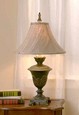 |
How tall should lamps in my bedroom and living room be? |
| Click to enlarge |
Some general guidelines for purchasing lamps for an adult room and major living areas are as follows:
Most
lamps
for nightstands should be a minimum of 24 inches tall. However candlestick
style lamps may be much taller and will look quite appropriate.
(Avoid using a tiny lamp on the nightstand, as it will be disproportionate
to the furnishings)
Lamps that are to be used on a dresser should be approximately 20 to 24 inches tall and can be any style you might like. However, I will point out that they should be different from the lamps used on the nightstands.
Lamps that are used for end tables should be approximately 28 to 32 inches tall. There are certainly exceptions depending on the lamp style, but use this as the general guideline. Another way to measure the optimum height of a reading lamp is to place it 40 to 42 inches above the floor, behind the readers shoulder. To avoid glare, the bottom of the shade should be a little lower than eye level.
 |
How do I know what size the artwork should be and where should it be hung? |
| Click to enlarge |
As a general rule of thumb, most art
pieces
should be hung at eye level. Of course, eye level is different for
different people. So try this suggestion, hang the center of the
art piece approximately 60 inches from the floor. If your family
is taller than average, you might want to raise it some, but do
not get carried away!
A key or important pieces of art to be hung over a sofa should be approximately two thirds the width of the sofa. This picture should be hung roughly 4 to 12 inches above the sofa. (Usually in the 6-8inch range) Rarely is a larger space between the sofa and artwork appropriate. If your artwork does not allow you to meet the above criteria, use several smaller pieces to create a grouping of similar space. This primarily holds true in other areas. Typically about two thirds width of the wall space should be covered. Combine this with the rule of thumb for picture height and you have got it!
Groupings, however, will often require the pieces to be hung at various heights for interest and balance. They eye level rule will not work for all the pieces in the grouping, but should be applied to a couple of the groupings components.
HAPPY DECORATING

|
|

